Example report · Two-session comparison
What a Tenth Finder session comparison looks like
Your session lined up against a faster reference lap, corner by corner — anonymized. It shows exactly where the time went and what to change.
Cameron Speedway
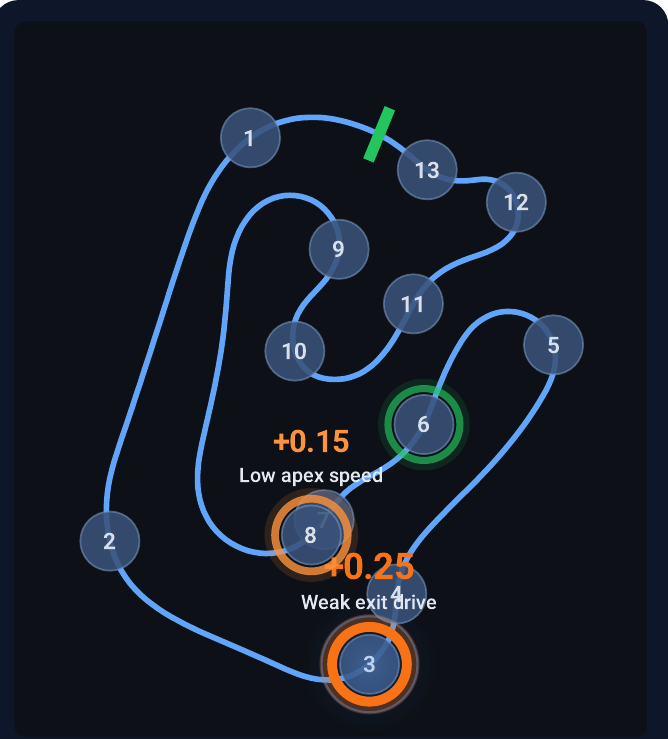
Track: Cameron Speedway
Best lap 53.007s, max speed 82 km/h, LO206 (4-stroke), 4 laps
Best lap 53.428s, max speed 81.2 km/h, LO206 (4-stroke), 16 laps
Weak exit drive off Turn 3 costs speed onto the following straight; over-slowing Turn 8 apex bleeds time through to Turn 9 entry
Turn 3 exit — student exits at 45 km/h vs reference 50 km/h (−5 km/h)
If You Fix Only One Thing: Turn 3 — raise exit speed from 45 km/h to match reference 50 km/h by improving line and rotation so the kart points at the exit sooner
Expected Gain: ~0.25s — roughly 60% of the total 0.421s gap
Nearly all of the 0.421s gap lives in two corners. Turn 3 exit is 5 km/h below reference, costing speed down the following straight. Turn 8 apex is 4 km/h below reference, which also slows the Turn 9 entry. Every other corner is within noise — the student is otherwise well-matched to the reference.
- Turn 3 entry (+10 km/h) and apex (+8 km/h) — carrying more speed in than reference
- Turn 5 entry (+8 km/h) and apex (+3 km/h)
- Turn 8 entry (+3 km/h) and exit (+2 km/h)
- Turn 7 apex (+1 km/h)
- Strong entry commitment: student carries more speed into Turn 3 (+10 km/h), Turn 5 (+8 km/h), and Turn 8 (+3 km/h) than the reference — no hesitation on approach
- Consistent mid-corner execution: Turn 2, Turn 4, Turn 6, Turn 7, Turn 10, Turn 11, Turn 13 all match the reference within noise across 16 laps — very repeatable
- Exit recovery at Turn 8: despite a lower apex, student still exits Turn 8 at +2 km/h vs reference — shows strong drive off the corner once the kart is pointed
Brake input cannot be measured from GPS speed. Entry speeds at most corners are at or above reference — braking is not the limiter here. The student is not arriving too slow anywhere.
Exit speed is the only measurable output. Turn 3 exit is 5 km/h below reference — the kart is not recovering speed onto the straight as quickly. This is most likely a line/rotation issue (kart not pointed at exit at apex) rather than a throttle timing issue, but fixing the arc will also improve the exit drive opportunity.
The core pattern is carrying too much entry speed into corners (Turn 3, Turn 5, Turn 8) without converting it into apex or exit speed. The reference trades entry speed for a cleaner arc and higher exit. Student needs to accept lower entry speeds at Turn 3 and Turn 8 to straighten the arc and point the kart at the exit sooner.
Very consistent across 16 laps — the pattern is repeatable, which means the fix will also be repeatable once found. Main inconsistency risk is Turn 3 where the entry/apex/exit pattern is far from reference.
Target 53.1–53.2s — fixing Turn 3 exit alone should recover ~0.15–0.20s
Target 52.95–53.05s — both Turn 3 and Turn 8 fixed, approaching theoretical best of 52.916s
You're fast into corners — now trade some of that entry speed for a cleaner arc so the kart is already pointing at the exit at the apex. The reference is slower in, faster out. That's the trade to make.
Target: Turn 3
Goal: Raise exit speed from 45 km/h to 48–50 km/h — accept giving up entry speed to get there
Drill: On consecutive laps, deliberately arrive slower at Turn 3 entry (target ~61–63 km/h). Vary turn-in point slightly each lap. Keep the lap where exit speed is highest. Ignore entry and apex numbers — judge only by exit speed.
Target: Turn 8
Goal: Raise apex from 56 km/h to 59–60 km/h — accept lower entry to clean the arc
Drill: Same approach — arrive at ~59–61 km/h entry, vary turn-in slightly, keep the lap where apex is 59 km/h or above. Check that Turn 9 entry speed also rises as a confirmation signal.
Target: String Turn 3 and Turn 8 fixes together in a full lap
Goal: Break 53.1s — theoretical best is 52.916s, so 53.0–53.1s is realistic with both fixes landing
Mental Focus: At each of these two corners, the job is to be pointed at the exit at the apex — not still turning.
| Reference | entry 59 km/h | min 56 km/h | exit 67 km/h |
| Student | entry 60 km/h | min 57 km/h | exit 67 km/h |
| Delta | entry +1 km/h | min +1 km/h | exit +0 km/h |
Summary: Matched — within noise, no issue here
Fix: Maintain
| Reference | entry 61 km/h | min 42 km/h | exit 50 km/h |
| Student | entry 71 km/h | min 51 km/h | exit 45 km/h |
| Delta | entry +10 km/h | min +8 km/h | exit −5 km/h |
Summary: Student carries far more entry and apex speed but exits 5 km/h slower — wrong arc, kart not pointed at exit at apex
Fix: Accept lower entry (~61 km/h), work line to rotate kart earlier so exit reaches 50 km/h
| Reference | entry 51 km/h | min 43 km/h | exit 55 km/h |
| Student | entry 52 km/h | min 43 km/h | exit 54 km/h |
| Delta | entry +1 km/h | min +0 km/h | exit −1 km/h |
Summary: Matched — within noise
Fix: Maintain
| Reference | entry 48 km/h | min 37 km/h | exit 51 km/h |
| Student | entry 56 km/h | min 41 km/h | exit 51 km/h |
| Delta | entry +8 km/h | min +3 km/h | exit +0 km/h |
Summary: Student arrives faster and holds more apex speed but exits identically — balanced, no controllable loss
Fix: Maintain
| Reference | entry 46 km/h | min 47 km/h | exit 62 km/h |
| Student | entry 46 km/h | min 47 km/h | exit 62 km/h |
| Delta | entry +0 km/h | min +0 km/h | exit +0 km/h |
Summary: Identical — no issue
Fix: Maintain
| Reference | entry 66 km/h | min 55 km/h | exit 63 km/h |
| Student | entry 65 km/h | min 56 km/h | exit 63 km/h |
| Delta | entry −1 km/h | min +1 km/h | exit +0 km/h |
Summary: Matched — within noise
Fix: Maintain
| Reference | entry 59 km/h | min 60 km/h | exit 61 km/h |
| Student | entry 63 km/h | min 56 km/h | exit 63 km/h |
| Delta | entry +3 km/h | min −4 km/h | exit +2 km/h |
Summary: Student arrives faster but apex is 4 km/h lower — extra entry speed scrubbed mid-corner, not carried through
Fix: Accept lower entry (~59 km/h), clean the arc to hold apex at 60 km/h; Turn 9 entry will recover as a result
| Reference | entry 57 km/h | min 41 km/h | exit 47 km/h |
| Student | entry 55 km/h | min 39 km/h | exit 47 km/h |
| Delta | entry −3 km/h | min −1 km/h | exit +0 km/h |
Summary: Slow entry inherited from Turn 8 apex/exit deficit — apex and exit match reference; no Turn 9 fault
Fix: Fix Turn 8 exit drive; Turn 9 entry recovers automatically
| Reference | entry 46 km/h | min 37 km/h | exit 53 km/h |
| Student | entry 48 km/h | min 38 km/h | exit 52 km/h |
| Delta | entry +2 km/h | min +2 km/h | exit −1 km/h |
Summary: Matched — within noise
Fix: Maintain
| Reference | entry 49 km/h | min 46 km/h | exit 60 km/h |
| Student | entry 48 km/h | min 46 km/h | exit 60 km/h |
| Delta | entry −1 km/h | min +0 km/h | exit +0 km/h |
Summary: Matched — within noise
Fix: Maintain
| Reference | entry 57 km/h | min 32 km/h | exit 47 km/h |
| Student | entry 54 km/h | min 33 km/h | exit 47 km/h |
| Delta | entry −3 km/h | min +1 km/h | exit +0 km/h |
Summary: Slow entry inherited from upstream — apex and exit match or beat reference; no Turn 12 fault
Fix: No fix needed here; upstream exit drive is the source
| Reference | entry 47 km/h | min 47 km/h | exit 50 km/h |
| Student | entry 46 km/h | min 47 km/h | exit 51 km/h |
| Delta | entry −1 km/h | min +0 km/h | exit +1 km/h |
Summary: Matched — within noise
Fix: Maintain